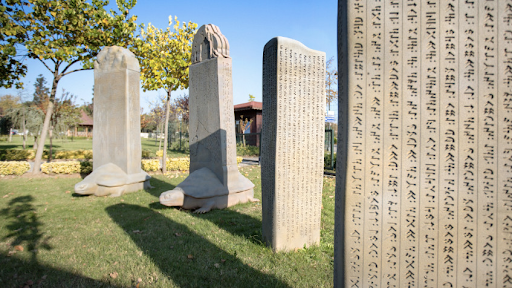
The Göktürks erected two memorial installations written in the Old Turkic alphabet in the early 8th century in the Orkhon Valley in modern-day Mongolia. They were constructed to honor two Turkic princes, Kul Tigin and his brother Bilge Khagan.
In both Chinese and Old Turkic, the inscriptions relate the legendary origins of the Turks, the golden age of their history, their subjugation by the Tang dynasty, and their liberation by Ilterish Qaghan. According to one source, the inscriptions contain “rhythmic and parallelistic passages” which resemble that of epics.
The inscriptions were discovered by Nikolay Yadrintsev’s expedition in 1889 and published by Vasily Radlov. The original text was written in the Old Turkic alphabet and was deciphered by the Danish philologist Vilhelm Thomsen in 1893. Vilhelm Thomsen first published the translation in French in 1899. He then posted another interpretation in Danish in 1922 with a more complete translation.
Orkhon Valley is a region on the western Orkhon River in modern-day Mongolia, near Ögii Lake. More specifically, they stand about fifty miles north of the Erdene Zuu Monastery and approximately twenty-five miles northwest of the Ordu-Baliq.
Little was known about Turkic script before Vilhelm Thomsen deciphered the Orkhon Inscriptions. The scripts are the oldest form of a Turkic language to be preserved. When the Orkhon inscriptions were first discovered, it was obvious that they were a runic type of script found at other sites, but these versions also had a straightforward form, similar to an alphabet. When Vilhelm Thomsen deciphered the translation, it was a huge stepping stone in understanding old Turkic script. The inscriptions provided much of the foundation for translating other Turkic writings.
The scripts follow an alphabetical form but appear to influence rune carvings strongly. The inscriptions are a great example of early signs of nomadic society’s transitions from the use of runes to a uniform alphabet, and the Orkhon alphabet is thought to have been derived from or inspired by a non-cursive version of the Sogdian script.
Both inscriptions are part of the Orkhon Valley Cultural Landscape UNESCO World Heritage Site in Mongolia. TIKA (Turkish International Cooperation and Development Agency) showed interest in the site in the late 20th century and finalized its project to restore and protect all three inscriptions. Since 2000, over 70 archeologists worldwide (specifically from Uighur, Turkmenistan, Azerbaijan, Uzbekistan, Tatarstan, and Turkiye) have studied the area and performed excavations. Fences with buildings for research work and storage of artifacts now protect the site. The total cost of the project is around 20 million dollars and will eventually include building a museum to house the inscriptions and other recently discovered artifacts.
The Göktürks erected them in the early 8th century. They commemorate the brothers Bilge Khagan (683–734) and Kul-Tegin (684–731), one a politician and the other a military commander. Both were descendants of Ilterish Qaghan of the Second Turkic Khaganate, a prominent Turkic nomadic society during the Tang dynasty.
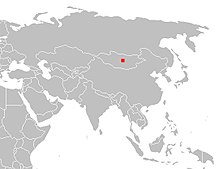
Location of the Orkhon Valley
The Göktürks have left artifacts and installations all over their domain, from Manchuria to the Black Sea. But only in modern-day Mongolia have any memorials to kings and other aristocrats been found. The ones in Khöshöö Tsaidam consist of tablets inscribed in Chinese and Old Turkic characters. Both monuments are stone slabs originally erected on carved stone turtles within walled enclosures. Bilge Khagan’s stone shows a carved ibex (the emblem of Göktürk Kagans) and a twisted dragon. In both enclosings, evidence of altars and carved depictions of human couples were found, possibly depicting the respective honorary and his spouse.
The Old Turkic inscriptions on these monuments were written by Yollug Tigin, who was nephew of Bilge Khagan. These and the Tonyukuk inscriptions are the oldest extant attestation of that language. The inscriptions clearly show the sacred importance of the region, as evidenced by the statement, “If you stay in the land of the Ötüken, and send caravans from there, you will have no trouble. If you stay at the Ötüken Mountains, you will live forever dominating the tribes!”.
Content of the Inscriptions
The two monuments themselves have engravings on all four sides. However, some of the script was not preserved or is missing; therefore, only portions of the original message remain. What follows is a summary of the most complete section of the inscriptions. One translation of the first and second monuments indicates that the text continues from one side to the other.
The first portion of the Turkic translations is Bilge Khagan discussing the commemoration of the tablet and mentioning the extent of the empire. One passage reads,
“To the East, I have made campaigns as far as the Shantung plain and almost reached the sea; to the South, I have made campaigns as far as Tokuz-Ersin and almost reached Tibet; to the West I have made campaigns beyond Yenchii-Iigiiz (Pearl River) as far as Timir-Kapig (The Iron Gate); to the North, I have made campaigns as far as the land of the Yer-Bayirku’s. To all these lands have I led (the Turks). The forest of Mount Otiikin has no [foreign] overlord; the forest of Mount Otiikin is where the kingdom is held together.”
The inscriptions also highlight Bilge Khagan’s accomplishment of uniting his people. As one passage reads,
“By the will of Heaven, and because I was greatly deserving and it so brought it about, I brought the dying people back to life; for the naked people I found clothing, the poor people I made rich, the scanty people I made numerous. I have made the other, which has a kingdom and a kagan, to stand higher. All the peoples in the four quarters of the world I have brought to keeping the peace and ending hostilities have obeyed and served me.”
The rest of the inscriptions are broken up and sporadic but seem to detail the conquests against the Kirghiz and the Tangut peoples, the death of Kul-Tegin in battle, and eventually, the succession of Bilge Khagan by his son. Bilge Khagan’s mother, El Bilga Khatun, was also mentioned in these inscriptions.
The following is an excerpt from the last paragraph of the inscriptions (in Old Turkic and English languages)

“You, Turkic and Oghuz lords and peoples, hear this! If the sky above did not collapse, and if the earth below did not give way, O Turkic people, who could destroy your state and institutions?”
Relations with the Chinese
The inscriptions have mixed views on Tang Chinese influence. On the one hand, it contains the view that the Turks despise the Chinese. Bilge Khagan wanted to distinguish his people from the Chinese to remain a solid independent society. In the inscription, Bilge Khagan reprimands those Turks who have been influenced by Chinese culture and have adopted a Chinese way of life. As one passage reads,
“Because of want of harmony between the begs and the people, and because of the Chinese people’s cunning and craft and its intrigues, and because the younger and the elder brothers chose to take counsel against one another and bring discord between begs and people, they brought the old realm of the Turkic people to dissolution and brought destruction on its lawful kagans. The sons of the nobles became the bondsmen of the Chinese people, and their unsullied daughters became their slaves. The Turkic begs gave up their Turkic names and bore the Chinese names of Chinese begs. They obeyed the Chinese Emperor and served him for fifty years. For him, they waged war in the East towards the sun’s rising, as far as Bokli kagan; in the West, they made expeditions as far as Taimirkapig; for the Chinese Emperor, they conquered kingdoms and power. The common Turkic people said thus: ‘I have been a nation that had its kingdom; where is now my kingdom? For whom do I win the kingdoms? said they. I have been a people that had its kagan; where is my kagan? Which kagan is it I serve?’”.
The claimed enslavement of the Turks also did not help the reputation of the Chinese. Bilge Khagan seems to blame the Chinese for the disunion of his Turkic state. This Turkic view of the Chinese is negative.
Orkhon inscriptions indicate prisoners of war have often designated the status of slaves. Inscriptions found in the First Turkic Khaganate also imply that terms denoting slavery or other forms of subordinate status, such as qul (male slave) and küng (female slave or handmaiden), are frequently applied to a population of defeated political entities.
However, the translation also reveals a degree of diplomacy with the neighboring Chinese, as evidenced by his statement,
“While I have ruled here, I reconciled with the Chinese people. The Chinese people, who give in abundance gold, silver, millet, and silk, have always used ingratiating words and have enervating riches at their disposal. While trapping them with their ingratiating talk and enervating riches, they have drawn the far-dwelling peoples nearer to themselves. But after settling down near them we have seen their cunning.”
Bilge Khagan also references the hiring of Chinese artists when he claims,
“From the Chinese Emperor, I have had artists to come and have set them to work. My request has been accepted. They have sent the Chinese Emperor’s court painters. I have bidden them set up a separate hall, and inside and out, I have had them to make various paintings. I have had the stone hewn; I have that which lay in my heart to utter. Understand this all as far as the suns and subjects of the Ten Arrows. I have had the memorial stone hewn.”
The inscriptions contain both Turkic and Chinese translations, further complicating the already chaotic view of the Chinese. Thus, the inscription shows that Bilge Khagan interacted culturally with the Tang dynasty.
written by Yağız Edited by Yağmur

 Yeni Yol News
Leave a comment